Monday, May 9, 2011

Gone With the Wind: Chapter 2

Summary: We learn that the secret behind Scarlett's changed behavior, with the Tarleton twins, is due to her massive crush on Ashley Wilkes. She refuses to believe what the boys have told her and goes to wait for her father to return from the Wilkes' Plantation where he was bargaining to purchase the wife of his Valet(?). We see that Gerald O'Hara is as stubborn as his daughter and they share a special bond due to their mutual nature. Mr. O'Hara tells us that the Wilkes Family is seen as something peculiar in the neighborhood as they care most about education, art, and higher forms of entertainment instead of the more practical things like hunting and gambling.


from http://krishnnaleela.files.wordpress.com/2009/03/gone-with-wind.jpg?w=468&h=391

KatieBug's Response: This is a chapter where we get to see the wheel's turning in Scarlett's head. She developed her infatuation with Ashley at a young age and has tried to manuever herself into being his wife ever since. Her father tries to explain that the Wilkes' are simply a different kind of "folk" and she wouldn't truly be happy with him in the end. I think he has a point, though I find it incredibly awkward that the Wilkes' always marry their cousins, it's almost like they're royalty. There's a certain amount of inbreeding there that I'm just not comfortable with.

Again, I find this part of the book incredibly similar to the opening of the movie and I have a new found respect for the screenwriters.


SammiDrake's Response: I think the book is slightly different from the movie in this chapter in how it paints Scarlett's love for Ashley. In the movie, we see a woman who wants Ashley simply because she can't have him . . . but you never really understand the big deal about Ashley. Seriously, why him? Now we find out, she's been jonesing on him for about two years now and he's just so different from all the other boys.

But Cher to Nick Cage-style, Gerald says "Snap out of it!" to Scarlett. But here, yet again, is where we start to see *theme* that Scarlett just isn't quite like the other girls in North Georgia. Gerald insists no other boy will want his daughter if she's moon-eyed over some lame guy who won't have her which, *spoiler alert* is really funny when you think about how Gerald scored his hot wife.

Wednesday, May 4, 2011

Gone With the Wind: Chapter 1

Chapter 1 Summary: Scarlett entertains the Tarleton twins upon them being expelled from the University of Georgia. Ever anxious to please Scarlett, the boys reveal a bit of gossip that is anything but pleasing to her ears; Ashley Wilkes is going to marry Melanie Hamilton. Sent away without the customary Southern Hospitality, Brent and Stuart Tarleton wonder what caused the sudden change in the object of their mutual affection. Afraid to go home, to face their mother's wrath, the boys discuss their possible dinner options giving the reader a short history of "the Troop."

from Full Movie Review


Katiebug's Response: The first thing I want to comment on is how similar the movie is to the book thus far, except for the 17 inch waist. We're getting the lay of the land, literally and figuratively, in this first chapter. There are the beautiful descriptions of Tara and the surrounding lands as well as details about the local "armies" being raised after the secession of the state. All the men seem preoccupied with the idea of war with the Union, while the women are concerned with the day-to-day problems like school and marriages.

I am a little surprised by the description of the master/slave relationships. It's not overtly tyrannical as I was expecting, it's much more subtle than that. (True, there are words used that my modern sensibilities are just not comfortable with.) It's the way the Tarleton boys regard their personal slave as they discuss where to go for dinner. But what I find really interesting is the way Jeems, a slave himself, talks about the slaves of lesser planters. It seems like the separation of the social classes extends to the slaves as well as the owners.


SammiDrake's Response: Yet again, the Tartletons prove just how low the admissions standards are for UGA and UVA showing that time really hasn't changed the schools of the South. (ZING!) That said, the first chapter is almost lifted entirely for the first scene of the film adaptation. It's setting up the idea that Scarlett is something special and unique in this Southern world *theme alert*.

Living just minutes away from the Margaret Mitchell House, I am well aware of the legacy this novel has in the South (particularly in Atlanta). I know this is the best-selling book behind the Bible (please fact check me) and often considered one of the best films of all time. It truly does capture the essence of the South in the mid-1800's . . . but I really don't find that a good enough excuse to explain how this book was written in 1936 (67 years after black men were given the right to vote) with the language and disregard for blacks that it uses.

It's no surprise - we all know that the US had slaves and we all know that slaveowners treated their slaves in a way that makes us cringe now. But the narrative of the novel also takes on this tone which makes it particularly difficult for me to get through.

Tuesday, May 3, 2011

Angela's Ashes by Frank McCourt

I finished reading Angela's Ashes, by Frank McCourt, during my flight home from Ireland this past week.  I have to say that I had a hard time putting this down.  Though the subject matter is anything but cheerful, the way the story is told is very entertaining.  It's almost a stream of consciousness narrative.  McCourt tells the stories of his life as if he were sitting in the room with you.

Frank McCourt details his childhood, growing up in Limerick, Ireland, amidst extreme poverty.  His father is an alcoholic who spends most of the what little money he earns in the pubs.  The mother struggles to keep everyone clothed and fed as much as possible, even if it means surviving on tea and bread.  His mother relies on charity to get them through, as there weren't many jobs for women at the time, and when McCourt is old enough he goes to work to help support the family.  This novel ends with McCourt's journey back to America and I may pick up the sequel to see how it all comes out.

One of the saddest passages for me to read was the one where he is certain that he caused the eternal damnation of a girl's soul.  His prayers for her miraculous recovery went unanswered and he was sure their sexual relationship had damned her.  It's only when he confesses everything about his life to a sympathetic clergyman that he's able to get some peace.  This moment, with him crying on the floor of the church, just brought tears to my eyes.  With everything else he had to deal with in his life this is where it all came spilling out of him.

I would definitely recommend reading this one.  Though, be warned, it is not a happy go lucky read and deals with some very depressing subject matter.  But it is beautifully done.

Thursday, April 21, 2011

Malcolm Gladwell's The Tipping Point

Ever since my undergraduate studies, I’ve been extremely interested in the application of economics. Taking the suggestion of my Globalization professor in my MBA program, I decided to pick up Malcolm Gladwell’s 2000 book, The Tipping Point.

Don’t be scurred of the book simply because I started off with my declaration of love for economics – you don’t have to be an economist or even think like one to understand Gladwell. He writes more about everyday events from a sociologist perspective as opposed to an economist perspective. So fear not.

As taken from Wikipedia, The Tipping Point can be loosely defined as "the moment of critical mass, the threshold, the boiling point." And Gladwell takes events such as the syphilis outbreak in Baltimore in the mid-1990s or the drop in New York City’s crime-rate or the resurgence of Hush Puppies popularity and describes how each event reached a point where an epidemic broke loose. Each event has some sort of, dare I say, tipping point that keeps all metaphorical hell from breaking loose. Once you reach that point, syphilis outbreaks or crime drops or hipsters aren’t the only ones wearing Hush Puppies anymore.

When change as such happens – it happens fast. To apply an economic principle, as Gladwell does, 80% of the work is accomplished by 20% of the people. Examples he provides are 80% of beer is consumed by 20% of beer drinkers, 80% of car accidents are because of 20% of drivers, so on and so forth. A small few wear Hush Puppies, a small few practice unsafe sex in combination with other things to pass on syphilis, a small few decide to straighten up and fly right in New York – and an epidemic breaks loose once it reaches a certain boiling point.

Want to know more about the Stickiness Factor as practiced by Sesame Street or Blue’s Clues? The Power of Context in Divine Secrets of the Ya Ya Sisterhood? Check out the book if for no other reason than to sound smart to your friends.

Tuesday, April 12, 2011

April Updates

I'm going to head across the pond next week and I intend to finish a book before I come back.  I had Angela's Ashes recommended to me and, since I am going to Ireland for 10 days, I thought I would read that on the plane.  So check back and see how that goes.

Also, my sister and I had a pretty in depth discussion of the movie, Gone With The Wind, the other day and we decided to read through the book together.  Hopefully this will start in May, one of us will read a chapter and then post, then the other will read the next chapter and post.  We'll comment on each other's entries, hopefully, and encourage anyone who wants to to read along.  Sort of reviving the online book club format I had with my friends a while back.

Monday, March 21, 2011

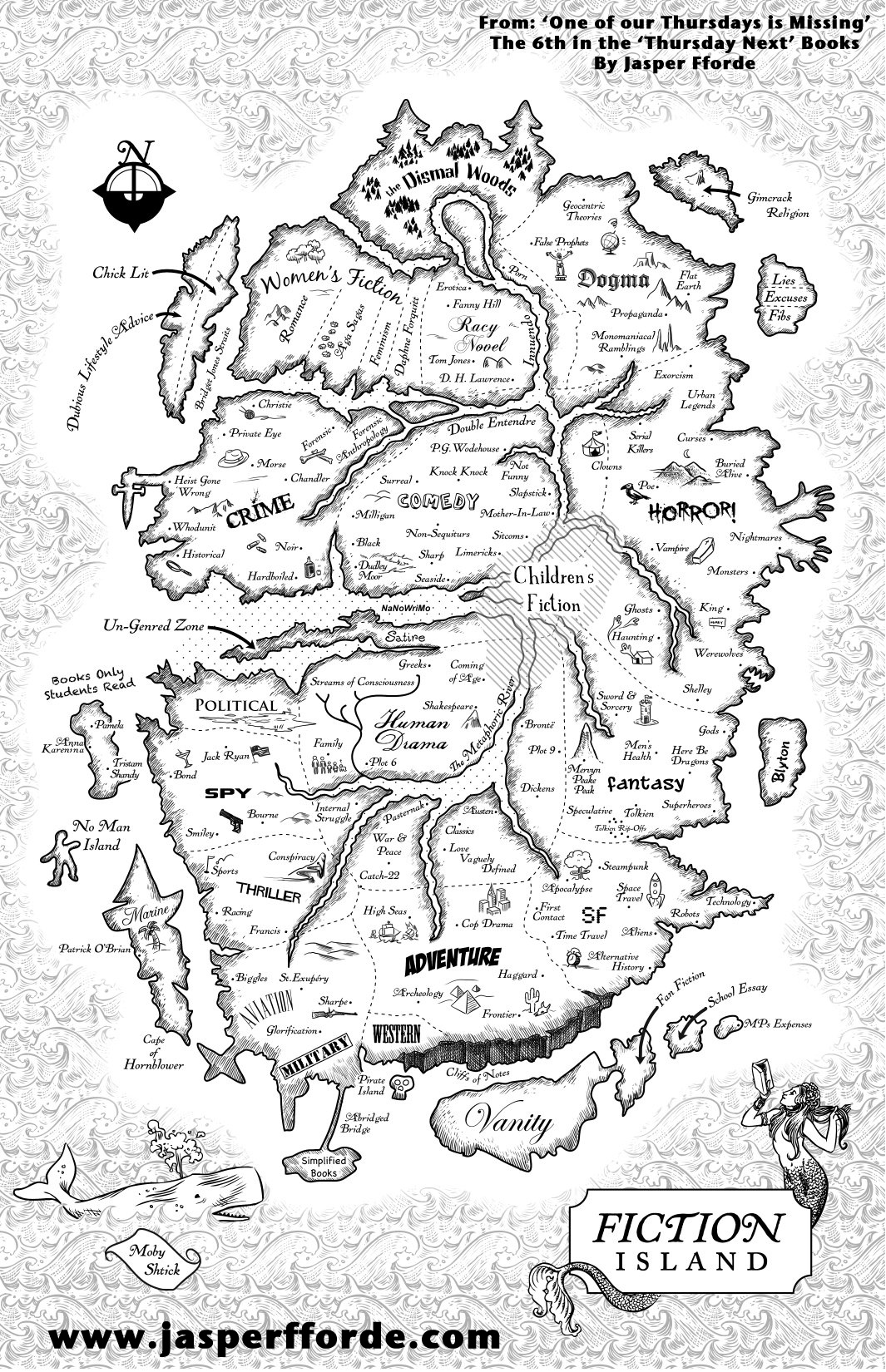
One of Our Thursdays is Missing by Jasper Fforde

Budgetary overruns almost buried the remaking before the planning stage, until relief came from an unexpected quarter. A spate of dodgy accounting practices in the Outland necessitated a new genre in Fiction: Creative Accountancy. Shunned by many as `not a proper genre at all,' the members' skills at turning thin air into billion-dollar profits were suddenly of huge use, and the remaking went ahead as planned. Enron may have been a pit of vipers in the Outland, but they quite literally saved the BookWorld.
Bradshaw's BookWorld Companion (16th edition)

from http://www.jasperfforde.com/

When I first received this book in the mail, from Amazon of course, I was excited to see a map drawn on the first few pages.  Every since I read the Lord of the Rings Trilogy, it's been one of my favorite things to see in a book.  I love to compare the location of things as I am reading through the story.  I have to admit I was somewhat confused by the map in this novel since readers of the series know that the layout of bookworld isn't entirely known to the reader or its inhabitants.  After reading the first few chapters I discovered the reason:  Bookworld was being reorganized to more closely resemble the Outland, or Real World.

Told from the point of view of the Written Thursday, what I really like about this novel is that Fforde is not afraid to completely change what we know about this world he's created.  He starts out with a different Thursday as his main character then reshapes the Bookworld.  It really keeps a reader on his or her toes and challenges what we have come to expect from this series.  I feel like I should have gone back and read First Among Sequels before diving into One of Our Thursdays is Missing as a few plot points from the previous novel were fuzzy and I was looking for answers in the new one.  This is clearly my own memory fault and not that of the author's.

Undoubtedly, this is still one of my favorite series and I highly recommend it to anyone.  The basic premise of the series is a character who lives in an alternate-reality Swindon, UK and has the ability to jump into novels and interact with the characters as if they were actors in a play.  Using Written Thursday as the POV on this one allows the reader to learn a little bit more about what it means to be a book character in the Nextian Universe.  Fforde pulls in a lot of our current events into this narrative and even touches on what the invention of e-readers has done to their environment. 

My other favorite quote from the book:
This was the annoying side of the feedback loop; irrespective of how she had once looked or even wanted to look, [the lady of shallot] was now a pre-raphaelite beauty... She wasn't the only one to be physically morphed by reader expectation....Harry Potter was seriously pissed off that he'd have to spend the rest of his life looking like Daniel Radcliffe.


Friday, February 18, 2011

The Travels of a T-Shirt in the Global Economy

The Travels of a T-Shirt in the Global Economy . . . how can 336 pages about the microeconomic look at how a t-shirt is made (from the beginnings of the US cotton industry to the cotton mills of yesteryear to sweatshops in Asia) and how the history of t-shirt production can be a good way of looking at globalization and the effects of free trade NOT be awesome.

Yes, markets and percentages of GDP and currency fluctuation and Cold War vs Globalization can be confusing if you’re not an MBA student (or hell, sometimes even if you are), but Pietra Rivoli does a pretty decent job offering a narrative that most anyone can understand what she’s talking about.

The big question is – even if you get what she’s talking about, will you find it interesting? Good question. The book starts off a little slow with a specific, detailed, micro look at the cotton industry and its origins in the United States, but really does make you sit back and think about where the t-shirt on your back came from. Whose sweat is responsible for that? Why did the US dominate the cotton industry? Some truths are tragic, others make you realize how great our country has become.

Cotton subsidies, yeah they screw over poor farmers in Africa who don’t have US subsidies and university resources, but at the same time, these poor African countries have their countries working against them (rather than for them as in the US). Sure the US cotton industry came about because of free labor in the form of slavery, but look at what’s it’s developed into and the people its helped.

The poor conditions of US cotton mills matched the poor conditions of British cotton mills decades before and holds a surprising resemblance to cotton mills in Asia at the moment. Are these Asian cotton mills entirely horrible if they eventually lead to skill enhancement and better lives (in the long run) for its people? In Britain and the US, cotton mills led to child labor laws and fair employment laws – whose to say that what led to the independence and well-being of so many people won’t lead to the same for their present-day counterparts?


The author does a great job of remaining impartial – instead of telling the reader that Chinese sweatshops are horrible or that using slavery to advance the cotton industry is bad bad bad – she lets you draw your own conclusion. These things are bad on a humane level, but they led/can lead to greater things.

Monday, February 14, 2011

Dragons of Autumn Twilight by Margaret Weis and Tracy Hickman


Image from Amazon.com
  My boyfriend suggested the Dragonlance Chronicles, by Margaret Weis and Tracy Hickman, as an interesting read.  I was hesitant to start this series as I have been burned by similar suggestions from former boyfriends.  However, I have to say that I was pleasantly surprised and plan to willingly continue the series.

I knew that the series was based on the Dungeons & Dragons Role-Playing Game and I was wary of how this would translate into a novel.  (I had read a few books based on a similar Vampire RPG and found it repetitive and dry.)  There were a few things that were clearly game based, i.e. the mage's limitations when it came to spell casting, but they weren't so glaringly obvious that I would have noticed if I hadn't been looking for them.

The descriptions of setting were my favorite part of this book.  The authors didn't get lost in them, à la Tolkien, but they certainly painted a vivid picture.  The beginning description of the town of Solace and the Valenwood Forest was so crisp I felt as if I could actually go there to see these massive giants and the town nestled within the branches.  Xak Tsaroth's description makes me feel like I am at the base of Niagra Falls once more, but with an aging city all around me.  Beautiful detail that envelopes the reader and engages the imagination.

The development of characters is a little predictable at times, but no less interesting.  The complicated back stories of Tanis Half-Elven and Raistlin Majere are enticing enough that I want to read more of the series and unravel the mysteries surrounding them.  These two characters, as well, are interesting in their decisions and motivations throughout the novel.  Some of the minor characters in this first book are two dimensional but I hope they are further developed in later novels.

Definitely a book I would recommend to anyone looking for a new fantasy series to read.

Tuesday, February 8, 2011

February Reading List

January had me unsuccessful in cleaning out the book queue.  I started reading a series that was recommended to me by my boyfriend, so that has taken precedence. To recap, here are the books I have carried over from last year:
The Writer's Tale: The Final Chapter by Russell T. Davies & Benjamin Cook (11/14/10) - Started 11/15/10
Changeless by Gail Carriger (10/16/10) - Started 10/24/10
Twenty Years After by Alexandre Dumas (6/01/10) -Started
A Clash of Kings by George R. R. Martin (08/01/10) - Started 10/25/10

Here are the new ones I added in January:

Dragonland Chronicles, Volume I: Dragons of Autumn Twilight by Margaret Weis & Tracy Hickman
Bonk: The Curious Coupling of Science and Sex by Mary Roach

Now I just need to stick to it and finish these before heading off-plan again.

Friday, February 4, 2011

"Do As I Say..." Webseries

Okay this is not exactly a book and I am changing the point of my blog to write about this.  But, my sister's high school friend, Andrea Schwartz, and her friend, Kim Kalish, are finished the pre-production on their web-series, "Do As I Say..."  Andrea started talking about it at Cinco de Mayo last year and it sounded really interesting.  Three friends, one of them pregnant with their first child, looking back on their early twenties and deciding to do a video advice gift for the baby.  I'm not sure if that is still the premise, but it's still about ladies in their twenties navigating their way through life, love, and professions in New York City.

One of my favorite parts about their website is their profile description
Kim and Andrea met in college where they majored in Theatre with a minor in Unemployment. In New York, they studied improv and sketch comedy with Upright Citizen's Brigade. They spend most of their time watching cat videos on Youtube.
They are lined up with a professional director, camera crew, lights, etc. so I can't wait to see the finished product.  I am very, very excited for them.  I know it's something on which Andrea has worked very hard and I love it when people see their labors rewarded.  It makes me feel like there is some sort of balance to the universe, or a legitimate reason to try for difficult goals.  Even if they don't fully succeed in this endeavor, for some unknown reason, the experience will be invaluable.  If only to know that you tried to reach that. unreachable. star.....wait this is sounding familiar.

I just really want them to succeed, okay?  If I could take everything that is in my heart right now and turn it into felix felicis, I would.  I am so very proud of Andrea for everything that she is doing.  So please consider visiting their website and backing the development of their series.